Sunday, December 11, 2022

The Caribbean; A short History


U
H HUH! When was the last time I did anything short? πŸ˜‡

A few posts back, I noted that it seemed like most cruise blogs seem to have a cast toward the Caribbean. Perhaps rightfully so. There are an awful lot of cruises there and an awful lot of cruise ship companies that offer cruises there. Traditionally, I think people (at least here in the U.S.) have thought of cruises as a warm weather vacation and reprieve from our sometimes-harsh winters. Caribbean cruising has expanded over the past few years. More and more Islands are now becoming cruise stops. We have made several cruises to and continue to cruise in the Caribbean ourselves. And as I describe these cruises, I often wonder a bit about the history of this pretty captivating part of our world.

"THE CARIBBEAN," a/k/a "The West Indies," derives its name - unsurprisingly -from the Carib native tribes that once populated this area of the world. Each time I do a "wiki" search of one of our ports of call, there is always a very brief mention of the former "indigenous" inhabitants. But never any depth. The current population of the Caribbean (we will attempt to define it better below) is about 41 million. That, presumably, is residents and doesn't include the substantial number of annual visitors. Different sources range that figure to between 25 and 35 million international visitors!

CONVENTIONAL "CARIBBEAN history" usually starts with something like, "when the Europeans arrived . . .  ." Who doesn't remember the (inaccurate and perhaps even revisionist) history of Sir Christopher Columbus' "discovery of America? As a very young person, I grew up thinking that meant he sailed into port somewhere in the U.S. and planted the Spanish Flag, claiming what we now know as "The United States of America" as Spanish territory. He didn't do that at all. 

BUT WHAT Columbus did "discover" (at least as far as Europe was concerned) was what we might call "the Americas" He was probably the most famous - and maybe first - explorer from Europe to do so. His first landing was in the Bahamas, which actually is neither the "New World" (U.S.), or the Caribbean (more on that later). The goal of Columbus' voyages was to find and confirm a presumed "shortcut" to the East Indies (essentially, Asia) in an effort to find an alternative to the sometimes treacherous "Spice Route." It wasn't until a year later, in 1493, on a second voyage to "the new world," that he made landfall in the actual Caribbean: St. Croix, (now part of the U.S.V.I.). He was a determined explorer, if nothing else. In 1494, he made landfall on what is now Jamaica. None of them were the East Indies. Ironically, the region he sailed to multiple times is referred to as "the West Indies."

SHORTLY AFTER Columbus' "discovery," other explorers and other European nations began to explore the area, including Portugal and France, and eventually England, as their navies and sailing fleets grew - partly as a result of the so-called "Age of Exploration," and partly because of the near-constant warfare and struggle for control of important waterways ensued between them. Eventually, the industrious and enterprising Dutch and even later, the Danish joined in. The Spanish did get there first and did declare the entire Caribbean Region to be Spanish territory. But they mostly concentrated on some of the major spots at first (Mexico, Cuba, Puerto Rico and "Hispaniola" - now Haiti and Dominican Republic). That left the other numerous islands up for grabs for the others. And they all got busy claiming, colonizing, and fighting each other over them.
The Caribbean

I THINK some geography would be helpful right about now. The "Caribbean" as we know it today, is formed by lands surrounding the Caribbean Sea. To the west and south are the mainland of Central and South America (Mexico, Belize, Honduras, Nicaragua, Costa Rica, Panama, Venezuela). To the north and east are the island archipelago of "The Antilles." The larger islands to the west (Cuba, Haiti, Dominican Republic, Jamaica and Puerto Rico are known as "The Greater Antilles." The numerous and mostly much smaller islands to the east are known as "The Lesser Antilles." Because Columbus was seeking (and may have believed he found) Asia and "The East Indies," the whole area above is also often referred to as "The West Indies." While as cruisers, we think of The Bahamas and Turks and Caicos as "The Caribbean," technically, they are not. Both are in the Atlantic (not in the Caribbean Sea). Because they continue to be important cruise points, I think we can continue to include them in our broad definition here, of "The Caribbean."


HISTORIANS BELIEVE that the islands were probably formed in a couple different ways. The Greater Antilles, it is believed, was most likely at one time connected to the mainland by land bridge. It is likely that much of the early migration of people were over that land bridge. In contrast, it is thought that most of the Lesser Antilles were most likely volcanic. Early inhabitants there most likely came by water. It is possible that Trinidad, the closest to the South American Peninsula was also attached by land bridge at one time.

BUT WHO was there before the Europeans arrived? The history of the inhabitants of the Caribbean is unclear. Most of what we know comes during and after the period of "discovery" which we will call, for convenience, the "Columbian" period.

SOMEWHAT SKETCHY history and archeology suggests that humans began to inhabit this region shortly after the Ice Age, and as long ago as 9000 B.C. Historians believe that Trinidad was probably the first inhabited Caribbean Island and was probably attached to the mainland by land bridge. I find it fascinating that historians attribute the eventual rising seas and disconnect of these now-islands to Climate Change. In 9000 B.C.!😐

REFERRED TO (perhaps euphemistically) as "Amerindians" the most probable early inhabitants were of Arawak descent and probably originated somewhere in the Amazon Valley, migrated up into Columbia and Venezuela, and then to the Antilles.

I find it fascinating that historians attribute the eventual rising seas and disconnect of these now-islands to Climate Change. In 9000 B.C.!

EVENTUALLY, THE Arawak origin branched to Taino, and perhaps, Carib. They all seemed to have similar cultures and the Taino, who seem to have emerged as the earliest settlers of the Antilles, shared the Arawak-based language (though the Caribs had their own, Kalinago language). Archeologists have found evidence on both the main peninsula and the islands in the form of elaborate pottery, ringed villages, raised fields, and large mounds, including evidence that they modified the soil using various techniques such as adding charcoal to transform it into black earth. According to historians, these are all indicators of a complex culture. The Taino appears to have been a particularly Antilles-based people. 

TO THIS world and culture, the Europeans arrived in the late part of the 15th century. And changed everything. This should not come as a surprise - at least not for any student of history. This was during what was known in Europe as "The Age of Discovery" (exploration), and dominant European nations (particularly those with robust naval and shipping capacity), began to explore - and conquer - the world. Spain, Portugal, France and England were continuously engaged in struggles for control both at home in Europe and around the world (including frequent hostilities in the Caribbean. Later, the Dutch and Danish would join the fray. Colonization (and exploitation) of many of these places ensued, including the Caribbean, the western Americas, and Mexico. This pattern continued for centuries. By the 17th Century, a new player, the United States, became involved.

AT FIRST, the Europeans discovered gold and other minerals in the Caribbean. They set up colonies, mined gold, traded (though often unscrupulously) with the native inhabitants, and eventually overcame them by force. Over time, the Europeans realized the potential in the rich soils and temperate climate for agriculture. The Caribbean was particularly suited to the cultivation of sugar cane and became at one time the world's largest producer and supplier of sugar and molasses. Sugar was a labor-intensive crop, and they began to import African Slaves into the region. This created an entirely new tension, which continued until well after the United Kingdon abolished slavery in 1833. It was not until 1865 that the U.S. finally passed the 13th Constitutional Amendment officially abolishing slavery in the U.S.

St. Kitts - Where some of the Residents live

THE BLACK slave culture produced a number of slave-rebellions throughout the Caribbean Region over the years. Perhaps the most famous was in Haiti and happened earlier - but is probably demonstrative of the atmosphere at the time. In 1791, a Haitian slave "uprising" ultimately became "The Haitian Revolution," (no doubt heartened by the U.S. Revolution just a few years early). The revolutionaries ultimately overthrew the French Colonial government and in 1804, Haiti gained its independence. Haiti still holds the distinction of being the world's first Black republic and was only the second (following the U.S.) independent republic in the western hemisphere.

A NUMBER of other Caribbean states gained independence in the years to follow. In 1821, Mexico, Guatemala, El Salvador, Honduras, Nicaragua and Costa Rica, all on the main South American Peninsula, gained their independence. In the Greater Antilles, both Cuba and Puerto Rico remained under Spanish control until 1898, following the Spanish American War. The victory by the U.S. in that war established the U.S. as the major power in South and Central America. In the 1898 Treat of Paris, the U.S. was granted control over Puerto Rico, and given temporary control and supervision over Cuba. Puerto Rico remains a territory of the United States. As a condition to full and final withdrawal of American troops from Cuba, the new Cuban nation signed another treaty, which essentially gave the U.S. "police-powers" over Cuba, agreeing that the U.S. could intervene militarily if they deemed it necessary. As later history would demonstrate, the tensions between the U.S. and Cuba grew and still exist to this day. Wouldn't it be nice if we could find a way to relax those tensions and once-again, allow cruise ship stops in Cuba?

TODAY, ONLY a handful of Caribbean territories remain under "colonial" control. Between 1958 and 1962 most of the territories who had not gained independence were controlled by the British, who years ago had established Naval Superiority in Europe. In 1962, Jamaica, Trinidad and Tobago became independent. In ensuing years Barbados (1966), Bahamas (1973), Grenada (1974), Dominica (1978), St. Lucia and St. Vincent (1979), Antigua (1981), and St. Kitts and Nevis (a federation - 1983) all gained their independence. Guadeloupe and Martinique remain French Colonies. St. Maarten and St. Bart's are "collectives" of France. The British continue to have colonial control over Anguilla, Bermuda, The British Virgin Islands (BVI), the Cayman Islands, Montserrat, and Turks and Caicos. And of course, the U.S. retains control over Puerto Rico, and the U.S. Virgin Islands (St. Thomas, St. John's, St. Croix and some very small islands).

Abandoned Sugar Plantation - St. Kitts

EVENTUALLY, THE sugar industry began to decline. There were a number of reasons for the decline, but in the end, the Caribbean ceased to be the world's largest producer. Sugar has remained, however an important crop. Today, other important crops include fruit (especially bananas), spices, and tobacco. Oil refining has also been an up and down component in the Caribbean economy. For a time, offshore banking was also a significant Caribbean industry. For wealthy residents of the U.S. these islands - once they became independently sovereign, were very convenient places for offshore holdings. That, too, has declined more recently, particularly in light the U.S. Patriot Act. Bringing us back to where we started. Tourism. It has become one of, if not the most important industry in the Caribbean.

Today, the Caribbean Islands are highly dependent on tourism

HIGHLY DEPENDENT on tourism, the Caribbean today, by my observation, the divide between wealth and the less economically fortunate is pretty obvious if you travel around these islands. In most instances, highly dependent on tourism, what we as visitors and tourist see is often what some want us to see. Our visions of the Caribbean - colorful, sandy beaches, restaurants and bars (think Sen'or Frog), and clean modern facilities - are usually present at the cruise ports and major tourist areas. But having done some touring on a couple of the island-interiors, I have seen some very poor, and other less economically fortunate residents and areas. It puts my own good fortune for the things I have and the place I live in a very different light.

St. Kits - Away from the Tourist Areas

I FOUND researching and writing this fascinating. It helps me put my Caribbean Cruise adventures into a better historical perspective. I will continue to research the individual destinations as we visit them, but this was a useful exercise for me, and I hope, an interesting piece for the readers here.

Sunday, December 4, 2022

The Caribbean - Again -2014

Celebrity Summit - Caribbean 2014

FOR THE third year in a row, we cruised in the Caribbean during the winter months of 2014. This time, ship was the Celebrity Summit. Our previous Caribbean adventures were first on the Ruby Princess in 2012, with family members, and then on the Celebrity Reflection in 2013, the O'brien wine group. The Summit is the fourth and final version of Celebrity's Millenium Class ships. This class is Celebrity's oldest and smallest class cruise ships still cruising, with an average capacity of just over 2,000 passengers. In recent years Celebrity has been updating and re-fitting them.
a cruise in the Caribbean has its own relaxing, almost "Conch time" atmosphere

THIS TIME, we cruised with a group of friends from our then hometown of Saginaw, Michigan. There were 5 couples on this cruise, all of whom were connected primarily with one of my law partners and me. We have traveled with this group - or parts of it - a few times. Always fun. Disappointingly, searching my archives, I didn't find any images of all 10 of us at the same time.

Caribbean - 2014 - Celebrity Summit

ONE DIFFERENCE this time was that we did not cruise out of Florida, where we have on every other occasion when headed into the Caribbean. This cruise originated in San Juan, Puerto Rico. Having stopped in San Juan on prior year's Celebrity Reflection cruise, we were excited to see it again. The old part of the city, appropriately, "Old San Juan," has a real "old world" feel, with old buildings and Spanish-influenced architecture, two old Forts guarding the Old San Juan Harbor, and the generally colorful Caribbean culture. In the port there are some great bars and restaurants and just off the beaten path, some perhaps even better local establishments.

Caribbean - 2014 - Celebrity Summit

WE WERE in for a surprise, however. When making cruise stops in San Juan, the ships port in the Old San Juan harbor. You are immediately in the town as you walk off the ship. But for originating and terminating cruises, there is another, more remote cruise terminal, which is where we boarded our ship. It turns out that it was only a mile or so from the old city, but at the time, we didn't really know that. We arrived at San Juan airport around noon on the day we were scheduled to depart. Sail away was early evening (maybe around 6 p.m. - that was a long time ago and the memory banks are not as efficient as they once were 😐). What we could see around us looked like we were very remote, and with only a few hours, the logistics of a taxi or other transportation for 10 seemed like it was not worth it. Nor did the (second) Senor Frogs (looking like the only place to go at the terminal) seem that inviting. If we were just going to mingle and drink with other passengers, why not just do that on the ship, where we had already paid for our drinks? So, instead, we stayed on board and began to take immediate advantage of our drink packages. At least it was warm and sunny - a welcome relief from the winter temperatures we had just left that morning. In retrospect perhaps we should have gone into Old San Juan, as it was "touted" as one of our ports of call. One of my "gripes" about Celebrity, as a matter of policy, is when they do that, and port in a remote location with either no, or not very hospitable means of transportation into the main attraction. There may be a blog on that topic in the future. For us, this was the first experience with that.

Not the "main" Senor Frogs (which is in Old San Juan right at the port) - 
this one was at the terminal - Caribbean 2014 - Celebrity Summit

I SOMETIMES wonder, these days, why we even go to the Caribbean, given that we live in an almost "Caribbean climate" now in the Tampa, Florida area. But we do love to cruise, and a cruise in the Caribbean has its own relaxing, almost "Conch time" atmosphere. I guess I answered my own question. 😁 Our experience has been that the weather is nearly always pleasantly sunny, the Caribbean clear and generally relatively calm, and the surroundings beautiful. We love to sit on the back of the ship and watch the sun set. And, sometimes, weather conditions conspire to demonstrate mother nature's majesty, like this rare, double rainbow of the Coast of Grenada in the Caribbean, during this cruise.

Double Rainbow - Caribbean - 2014

ANOTHER DIFFERENCE in this cruise was that we went to some places we had not been to before. We have done at least 6 Caribbean cruises over the years - and are certain to do more (including a planned, February 2023 cruise). For the most part, it seems like a lot of our stops are "been there, done that" repetitive. Most of our Caribbean cruises have been to the so-called, eastern Caribbean, and have so often included St. Thomas, St. Marteen, St. Kitts, and San Juan as to call them "regular" stops. This, though it did include St. Thomas, was to mostly new places, like St. Croix (U.S. Virgin Islands), St. Lucia, Dominica, and Grenada.

Main Street - St. Croix, USVI - 2014

FROM SAN Juan, our first stop was St. Croix, USVI. We left the port on a Saturday afternoon, so our day on shore here was a Sunday. As is true of most of these island ports, tourism is a major industry. The history of St. Croix is similar to most of the other islands in the Antilles Archipelago. Beginning centuries before, with the migration of "indigenous" tribes of the Caribbean, it was "discovered" by Columbus in 1493. The island was populated and controlled at times by the Dutch, Spanish, British, and finally, Denmark for a period of time. During this mixed history there were long periods when the island was uninhabited.

The old Fort protecting the port, and the long stretch of white beach beyond
contribute St. Croix's tourism industry - Frederickstat, St. Croix - 2014

IN 1916, Denmark sold Saint Croix, St. Thomas, and St. John to the United States. These islands now form the U.S. Virgin Islands (USVI), an incorporated U.S. territory, whose capital is in Charlotte Amalie, St. Thomas. The island's inhabitants were granted United States citizenship in 1927.

Frederickstadt Cemetery - St. Croix - 2014

THE ISLAND houses one of the largest oil refineries in the world (formerly built and operated by the Hess Corporation in the 1960s). St. Croix is also the home of the Cruzan Rum distillery (interestingly, the distillery imports most of its sugar cane for rum production from Dominican Republic and South America). There is also a second distillery which produces Captain Morgan Rum. I didn't know about the rum distilleries when we visited. On a later Caribbean Cruise in 2015, I sought out some good rums - but mostly while we were in San Juan. Because we were in St. Croix on a Sunday, I doubt we could have arranged a tour/tasting for either facility. But it is something to think about for the future.

Frederickstadt - St. Croix, USVI - Celebrity Summit - 2014

SO MANY of these very small Caribbean Islands (a number of them, nations; others, territories of larger nations), away from the commercial cruise ports, are generally quite poor and depressed. At one time almost wholly dependent upon tropical agricultural products (bananas and other fruits, coffee, cocoa, sugar, spices, etc.), they are now highly dependent on the tourism economy. And even then, I think a lot of the retail establishments in the port area are owned by or affiliated with larger - worldwide corporations, leaving much of the income generated by the islands to taxes and employment of its citizens. You can see this in the photos I made in Grenada. The second image is what you see immediately outside of the port area. 

THE FOLLOWING day, our port was St. Kitts. My wife and I had been there in 2013 and had taken the narrow gage railroad up into the sugar plantations, and catamaran sail around the island. This time, our group was more ambitious. Well, some of them. There were five couples. The three "most athletic" of the guys (they all ran regularly and were reasonably fit for 3 "old guys" 😐) decided they were going to climb a volcano. The activity level was described as something like "moderately strenuous. Later, when they returned, all 3 admitted it nearly killed them. And they looked like they had been through a battle. The ladies all decided to take a jeep safari, and from what I can tell, they had a blast. The other two guys (you know, the ones who knew their limitations) exercised a little common sense, and just went ashore and wandered around. We may have provided the most important part of the day though. We found the spot where the beer was only $1!

The Sweet Lime - St. Kitt's - Caribbean ($0.99 beers)

ST. KITTS (short for St. Christopher) may be one of the most colorful of the Caribbean Islands. This was certainly true in and around the cruise port. But we even saw colorfully painted houses well back into the island during our Sugar Plantation excursion the year before. There was also a certain "local color" that often presented itself at as a photo-op.

This young woman offered to pose for me. How could I say no? 😐 - St. Kitts

AFTER WE had a few of those $1 beers, we ultimately found our way back to the ship. We may have had a little help. 😁

St. Kitts - Caribbean

OUR NEXT stop was another island we had never been to: Dominica (pronounced "domineeka," with the accent on the 3rd syllable). A part of the Windward Islands in The Lesser Antilles, this tiny island is its own commonwealth. Again, originally populated by indigenous Caribbean tribes, the island was colonized by France, sometime in the late 1490s. At that time, coffee was the primary commodity produced on the island and the French imported African slaves to work the coffee plantations. Following the Seven Years War between Britain and France, Britain took possession of Dominica and maintained it as British territory until 1978, when it was granted its independence and became a sovereign nation in its own right.

Roseau Cruise Ship Berth - Dominica - Celebrity Summit - 2014

DOMINICA's CAPITAL city is Roseau. The Roseau cruise ship berth (there is only room for one ship to tie up, so we were the only ship there) is surprisingly unprotected. I was impressed by how high above the island our upper cruise ship deck placed us. My photo of the dock leading from the ship to the island has always been one of my favorite cruise photos, with its graphic sweep onto the island.

One of the numerous local bars found on every Caribbean Island - Dominica - 2014

WHILE DOMINICA is known for its share of natural wonders, and has active volcanic activity, we didn't do much in the way of onshore tours or activities. Maybe some recovering from the prior day's activity? But the pattern here was a frequent feature of this cruise. We were all from Saginaw, Michigan which in February is deep into the throes of winter. We are usually weary of cold, dark, snowy and sometimes grimy conditions, with short days, long nights, and very little sunshine. A Caribbean vacation to us was about sun and relaxing. So, we weren't very ambitious for the most part. In most cases, we generally got of the ship for a couple hours, walked around, maybe did some souvenir shopping, and found a local bar to sample the local beverages (primarily the Caribbean beer offerings for the majority of us. Then we decided that since we had already paid for the "drink package" on board, we might as well go back to the ship.

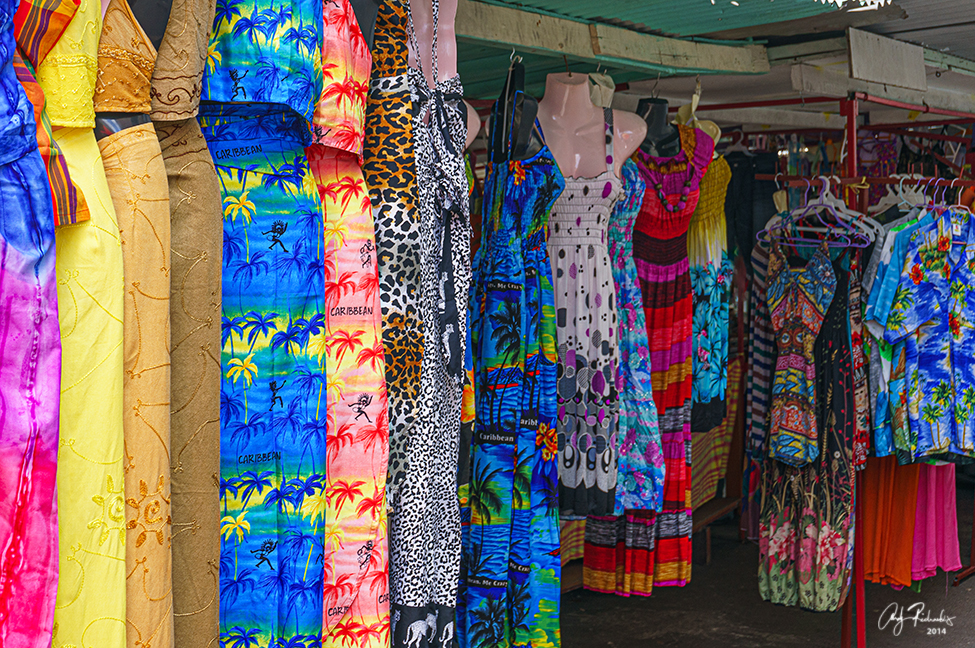
Colorful clothing is a hallmark of the Caribbean - one of the ubiquitous shops - Dominica - 2014

GRENADA, OUR next stop on the following day is, perhaps at least for us Americans, best known for the 1983 U.S. invasion during the Reagan presidency. We docked at the cruise port terminal in the capital city: St. George's.

Grenada - 2014
FOR MY wife and me, this stop became kind of a "bust." Our group had booked a "golf cart" driving tour of the island. But my wife had a (very minor, but enough to hold us back) "medical" issue and we ended up not joining the rest of them. They did say upon their return, that they enjoyed the tour. In our case we went back aboard and got some medical attention. It is the only time I have seen the "hospital" area on the ship - and I hope it remains the only time during my lifetime! Not a cheery place compared to the other areas of the ship. Anyway, that being done, we did walk around the port area, briefly.
St. George's, Grenada
BEFORE THE arrival and colonization by the Europeans, Grenada was inhabited by the Carib tribes. They were initially quite resistant to European incursions. It is believed the Columbus sighted the island in 1498 (by then he had already claimed all of the Caribbean for Spain), and that perhaps Amerigo Vespucci again in 1499. But it was the French, who eventually began to colonize the island. The first French colony followed a French expedition from nearby Martinique, in about 1649, establishing a permanent French settlement (probably somewhere around St. George's). The French and the Caribs originally signed a short-lived peace treaty. Conflict soon arose and continued between the Carib inhabitants and the French until 1654. Sadly, by the 1700's the majority of Caribs had virtually disappeared from Grenada (though they continued to inhabit other islands and continued to skirmish with the Europeans). Over the next couple centuries, control of Grenada see-sawed back and forth between France and England. Ultimately, by the late 19th century, British control had been established and Grenada became a part of the West Indies Federation under the ultimate control of the crown.
Cruise Port Entrance - Grenada - 2014
IT WAS not until 1974, after unrest and protests over labor treatment that Grenada was granted independence and the status of a nation. In prior years, the colony primarily grew sugar and indigo, and - not surprisingly - the French imported 100's of African slaves to work the plantations. In 1714, cocoa was introduced to Grenada. In 1843, nutmeg was introduced. Both are important crops for Grenade, which supplies roughly 40% of the nutmeg produced worldwide. Today, Grenada is sometimes known as "The Spice Island."
Grenada - 2014
IN 1979, while the prime minister was out of the country, a Marxist Group effected a "bloodless coup," removed the government and prime minister, and established control of the government with a Marxist regime. Over the next 4 years, unrest continued. The regime, while outwardly "neutral," was known to cooperate with USSR and maintained close ties with Cuba. Eventually, another coup occurred (this one not so "bloodless") and a Marxist Military regime established. In 1983, in a very controversial action, the U.S. invaded Grenada and captured the Marxist government. The original 1974 constitution was restored, as well as "democratic" elections. By most accounts, the nation has remained mostly stable since. These days, like virtually every other Caribbean destination, they are hopping on the tourism bandwagon - and in that regard, they are pretty much like every other Caribbean Island.
Scenic Overlook - Magens Bay - St. Thomas, USVI - 2014
WE SPENT the next day at sea. Our last stop of the cruise was St. Thomas, USVI. The primary cruise port on St. Thomas is the USVI capital, Charlotte Amalie. We had been there on our last cruise, and I remembered Charlotte Amalie as mainly kind of touristy, and dirty. I think that in order to see the best of St. Thomas, you need to get out of town. Some of our group wanted to do some shopping in downtown Charlotte Amalie, so our plan was basically to get off the ship, walk around the downtown for a bit, and get back on the ship to enjoy our final sunny day in the Caribbean. But that morning, as we walked off the ship, we decided it might be nice to get a ride up and see the most popular beach in the area - Magen's Bay - and see some scenery, before being dropped off in the downtown. We jumped into one of the ubiquitous multi-passenger "golf carts." Our driver took us up to the beach and we got a look. It looks like a nice place for a day at the beach. The horseshoe shaped, nearly 1-mile long, sandy stretch is pretty, and there is lots of space for beachgoers. On the way back down to the downtown area, our driver detoured us up to what is probably the highest point on the very mountainous island, and to a viewpoint, where we were able to observe Magen's Bay from above - and of course - photograph it. After some "window" shopping and a few souvenir purchases, we ended up at a bar near the water in Charlotte Amalie (surprise). There, I heard for the first time, a story that I am certain is oft told to tourists visiting these island paradises. Our waitress asked where we were from. Eventually we go around to her, and she was from somewhere in the U.S. (I don't even remember - it's not really important to the story😎). The upshot was she said that she was from (somewhere) but that she now lived on St. Thomas. When we asked how she got here, she said she was on a cruise and got off the ship for the day in St. Thomas. And then never went back! πŸ˜‰Yep. Unique story, I am sure! But still fun.

A fun end to a fun week. We would plan to do it again next year (as it turned out, the "crowd" thinned a bit from this year, but still a fun time)! We didn't cruise again until 2015. And when we did, it was once again, back into the Caribbean.

Sunday, November 27, 2022

Cruise Intelligence Gathering

Celebrity Apex - 2022
WHEN I decided to do this blog, it was a whim. I have been blogging since 2007 about my photography, related travel, and musings as LightCentricPhotographyBlog. I have blogged there at length about all my travels, including cruises. The LightCentric blog is, and will remain, my main blog and focus. But it has always been from a photography-oriented perspective. Obviously, I feature a lot of my photography here, but the intent of this blog is to be more about just cruising and related things. A little research will reveal that there are 1,000's of Cruise and Cruising related blogs and/or websites. It seems to me that most of them are monetized in some way - many of them offering cruise-travel related services and many of them being operated by cruisers-turned-travel-agents. Also, an inordinate number of them - it seems to me - focus on the Caribbean and Alaska. With one or two exceptions, I think the largest one, Cruise Critic, will probably give you everything any of the others do, and more. And all the information is in one place (more on Cruise Critic below).

I DON'T plan to do what most other cruise blogs do here. This blog - admittedly a bit self-centered - aims at my own cruising experiences and thoughts, and things that might logically follow from those thoughts (maybe even some illogically πŸ˜†). There is a possibility that readers might get a nugget or two of useful information, as well as finding it interesting and/or amusing. Most of all, I want it to be fun!

MANY CRUISERS, whether first time cruisers, or "seasoned," do some research on cruising these days. If it is your first cruise, you may want to peruse some of the generic sites out there. If you are experienced, you may already know some of the sites I will mention here. They are designed to give you "intel" for your upcoming cruise, in the form of "on-the-ground" information and observations, as well as insights and Q&A for your cruise. Traditionally, they have also served the important role of getting people together (at least digitally), pre-cruise. The best starting point will probably be two places: Cruise Critic, and Facebook.

AS WE completed a few cruises, we learned that there are a lot of really good private excursion opportunities in ports. Usually, we feel that they are superior to those operated by the cruise lines; offering smaller groups and more "tailored" tours. A little-known secret is that these private, small group tours are often not significantly more expensive than ship tours (which can have as many as 50-60 participants). We have found that our personal "sweet spot" is about 8 participants. But if you aren't cruising/traveling with 6 other people, how do you arrange 8-person tours with complete strangers? That is where the "intel" sites are helpful, so stay tuned.

LIKEWISE, AFTER some experience, we learned about a few "insider" tips, including "do's and don'ts," stateroom positioning, and just general information about cruise lines and ships. One of my "beefs" with all the newest travel websites (dominated by Tripadvisor), is that they have progressively become less user-intuitive to navigate as they have worked to dazzle us (and to sell us). Information we don't really need (especially the experienced cruiser) is front and center. Stuff you would think should be made easy to find, often is buried. You may need to dig some to find what you need. But for the most part, it is there.


IN 2013, when we discovered it as a resource, the primary place for this kind of organizing was a website known as "Cruise Critic." It touts itself as the largest and most comprehensive cruise site. That is probably right. First published in 1995, in 2007, it was acquired by Tripadvisor, which most likely explains its substantial reach. Of course, the Cruise Critic site has many other functions, being one of the most comprehensive "cruising" sites out there, with forum-type boards (with 100's of essentially uncensored reviews by passengers), as well as myriad information about cruises, cruise lines, ships and ports. For us, the most useful aspect of the Cruise Critic site has been what they call "Roll Call." In that part of the site, you can search for your cruise line, ship and date of the cruise and more than likely, someone has started a "Roll Call" for your cruise. This is usually done by a member who will be sailing on the cruise. Once a Roll Call is established, you can join in the conversation (or establish it yourself, in the unlikely event is has not already been done). However, as noted above, the "Roll Call" section is not anywhere obvious on the site. Fortunately, they have a search box where you can type in "roll call,") or you can try my link). Then just follow the directions to find your roll call.

IN ADDITION to general discussion about the ship amenities and the ports of call, one of the most useful features of the Roll Call has been to connect with other people looking to do one of the private small group tours. Most of the time, the tour operators have a set price (for example, $$ per group for up to 8 people). One person can book it if they wish, but the cost will be the same. So, it is advantageous to seek out enough people to fill out the group, or to ask to join a group that is looking for more people to fill it out. We have had great success, doing this both ways over the years through the Roll Call pages on this site.

[Insider Tip: Tours with drivers offering smaller groups (4 or less) often use small sedans. 4 good sized adults plus driver can be uncomfortable. We know from experience. πŸ˜“ Depending on the tour, and its length, we will often either look for 6-12 person groups. But at times we have cruised with other couples where we frankly don't want to share our tour guide 😎 (in other words, we want just the 4 of us). We have learned to book an up to 6-person tour - even though we will only be 4, and just understand that we will be paying more. It's a judgment call whether it is worth it].

WHETHER WE will continue to have such success may depend upon a number of factors. The 2021 Covid Pandemic (as it did with most aspects of our daily lives) resulted in major changes to cruising. Basically, for a period of just over a year, cruising essentially halted. We had at least 5 cruises cancelled during that period. We had credits on one line and kept trying to move it forward, only to have it cancelled. We were finally able to re-schedule a Baltic Cruise in late summer of 2022. But world events continued to conspire against us. The highlight of the Baltic Cruise was an overnight (essentially two days in port) docking in St. Petersburg, Russia. Until a crazed, dictatorial "president" of Russia got his "Hitler" on. It didn't take long before the St. Petersburg stop was eliminated. While still an interesting cruise it put a pallor on exciting anticipation many booked cruisers had. Indeed, that was demonstrated as more than 50% of the passengers cancelled the cruise (we went, had a great time, and think perhaps the less than 50% of normal passenger numbers may actually have been a benefit).

WHAT DID happen was the roll call on Cruise Critic for that cruise was, lacking a better description, anemic. There were virtually no seekers/takers for private shore excursions. Some speculated that the cause was a large amount of unused and accumulated "on board credits." Others of us think it was attributable to uncertainty, and a certain amount of "malaise" over the loss of the St. Petersburg stop. For whatever reason, the roll call was pretty disappointing. As we look at future cruises, it appears to be slowly heating back up again, and I would still highly recommend signing up and spending some time there.


THE CURRENT hotspot is - shockingly πŸ˜‘ - Facebook. I have commented about this on both of my blogs. Originally, Facebook's founder envisioned the social media site as the next and best social media platform for college kids (a few oldsters may remember its predecessor, MySpace). Instead, Facebook has really become the darling platform of the baby-boomer generation. Millennials embraced it only briefly before moving on. But my generation seems to have wholeheartedly bought in. I confess I have both a personal presence and a page on FB. That doesn't mean I have to like it. 😈 I do find it a nice platform for my photos and for family and light social interaction. I try not to participate in the political madness there (and I totally do not care about your "Wordle" score 😏). Nonetheless, Facebook seems to me to have become the "Go To" place for an awful lot of people to get information and even news. πŸ˜• Today, that is also true for cruising. Recognizing that you basically must have a FB presence today, the major cruise lines have their own FB pages/groups. Even Cruise Critic has a FB page. And, not surprisingly, private/public non-affiliated groups have now been set up. The FB equivalent to the Cruise Critic "roll call," are "Private Groups" specifically labeled by cruise ship and date. You have to request to join and be admitted. They then act in much the same way as the roll calls did (though in my view, kind of "FB-dumbed down").

THESE TWO sites should probably be the main places you go first to obtain relevant cruise "intel." Between them, you can learn a lot about the ships, the ports, the cruise line policies, current events (i.e., Covid protocols), and things like passport/visa requirements. They are also the place to get general tips on cruising and cruise travel. And of course, they will feature a lot of reviews by members/passengers. CAUTION: These sites (especially Facebook) are also a place to get a lot of misinformation. Remember that the posters are just folks like us, and often the information is nothing more than opinion, no matter how staunchly stated. Like anything else on the internet, you have to put on the common sense/BS/attitude filters on your searches. 😐 There will always be "fanboys" (and girls). There will always be chronic complainers. There will always be the occasional "entitled" person. But with judicious sorting, there is a lot of good and factual information along with a fair amount of misinformation.

THE OTHER place you need to go to and keep up with is your cruise line's website. Understand that they will be in "sell/promote" mode and will likely not report anything negative. Like the other sites, I find them generally hard to navigate when you are looking for something specific and useful. Like the other sites, they are designed to sell you things. But they are still often the best source to verify factual information that you may be getting conflicting information on. They are also the place you will probably go first, for a view at 10,000 feet of the ports of call. But don't stop there.


WE USUALLY start looking for things to do in a port on TripAdvisor. We then branch out to a couple of other places we have experienced. In a couple cases, we just re-contact a driver or tour operator we have already used. We have also discovered a couple of public general operator-networks who do a really fine job. One is "Tours by Locals." They are a Canadian Company whose advertising notes that they "hand-pick" local guides to match up with travelers. It is usually someone looking for a private to semi-private, more unique experience (while in Lisbon, Portugal in June 2022, for example, 4 of us went to the home of a local resident who cooked - with us participating - a typical family meal for the region). They say that they provide startup consultation and marketing materials (presumably specifically geographically target) for their network members. There is a very general section on how to "become" a Tours by Locals tour guide on their website. They also provide the locals with an online payment processing system. Tours by Locals is paid a commission - presumably as a deduction from the collected tour payments. The locals, by and large, set the prices themselves, as well as the itinerary. It is possible to arrange for customized tours.

THERE ARE also a few "free" walking tour operators. Perhaps the best known company currently is Free Tours By Foot. But there are others.  In some cities there are alternatives, and we have found and used them. Often you will find them during your online searches and they may be just local or regional operators. Free Tours By Foot has a pretty wide "footprint" (see what I did there? πŸ˜€) in most major cities around the world, and a pretty sophisticated website. We have had a lot of success with a couple of these organizations finding and planning fun, informative and useful shore excursion tours. The word "free" is (should be) a bit of a misnomer. These tours are set up by a schedule and are limited to a manageable sized group (8-10 seems the norm) for walking around a city. There is no charge for these tours, but you are asked to "tip" what you think the tour was worth at the end. We have usually tipped anywhere from $40 (local equivalent) to $50 for the two of us (ocassionally more if we thought circumstances warranted), depending on the length and possible other factors. So, I suppose you could theoretically do these "free." I hope you are not that kind of a person. πŸ˜’The tour guides are usually local residents (they may not be native, but they live locally), who may be students, actors, or working in other part-time employment. They are generally engaged and very knowledgeable, and approachable.  Some of them do it as a sideline. Others do it as there primary income source. There are also some you-Tube clips that you can watch to get an idea of how things work.


FOR PAID private tours, we usually find them on TripAdvisor (or on Cruise Critic or FB by joining already set up tours). If we are interested, we will then go on our Cruise Critic Roll Call or FB page and solicit joiners.

THE WORLD appears to be driven by the internet these days. Everyone has a presence somewhere. But don't neglect other, more traditional means of research and intel. I still often purchase guidebooks (my general favorite being the Rick Steves series). There is often a lot of easy-to-find information there and they can be carried along on the cruise, with pages dog-eared and information highlighted. Whatever you do, don't be afraid to dig a little bit. And along the way, don't forget to have fun!